President Donald Trump displays an executive order on artificial intelligence he signed at the “Winning the AI Race” AI Summit at the Andrew W. Mellon Auditorium in Washington, DC, on July 23, 2025. (Photo by ANDREW CABALLERO-REYNOLDS/AFP via Getty Images)
Databricks’ Todd Schroeder explains why agencies are prioritizing the use of AI that works across existing data environments, saving time and infrastructure costs.
With mounting security mandates and growing complexity, HPE’s Bob Friday says federal IT leaders must look to AI-enabled, cloud-based models to meet mission needs.
For the federal government to move beyond isolated AI experiments, agencies must adopt an "AI factory" model that securely aligns data, infrastructure and people to deliver mission-critical…
President Donald Trump holds up an executive order after signing it during an education event in the East Room of the White house in Washington, DC, March 20, 2025. (Photo by ROBERTO SCHMIDT / AFP)
Under the executive order, agencies must make full use of tech in environmental review and permitting processes for “infrastructure projects of all kinds.”
By combining strategic foresight and practical execution, federal agencies can use generative AI to improve citizen services and operational efficiency, say DHS’s Chris Kraft and HPE’s Bill…
AI workloads will likely become the principal workload driving government operations by 2030. That will require agencies to plan now for accelerated, AI-ready on-prem infrastructure that works…
WASHINGTON, DC – JULY 12: U.S. Vice President Kamala Harris listens as Arati Prabhakar (R), the director of the White House Office of Science and Technology Policy speaks during a meeting on Artificial Intelligence in her ceremonial office in the Eisenhower Executive Office Building on July 12, 2023 in Washington, DC. Harris hosted the meeting to discuss AI with civil rights leaders and consumer protection experts. (Photo by Anna Moneymaker/Getty Images)
Cisco’s senior director for federal civilian agencies highlights recent federal initiatives to modernize agency operations — and why software-defined platforms help agencies achieve “breakthrough outcomes” faster.
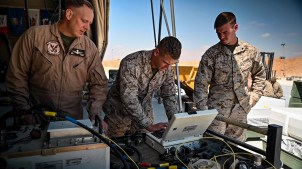
Marine Fighter Attack Squadron 115 aviation ordnance technicians load compatible software for a U. S. Air Force Guided Bomb Unit 38 to be employed on a U.S. Marine Corps F/A-18 Hornet proof of concept mission at an undisclosed location in Southwest Asia, March 14, 2022. (U.S. Air Force Photo by Master Sgt. Christopher Parr)
Chris Lynch, founding director at Defense Digital Service, shares why it's important for the Department of Defense to invest in the infrastructure to power its software needs.